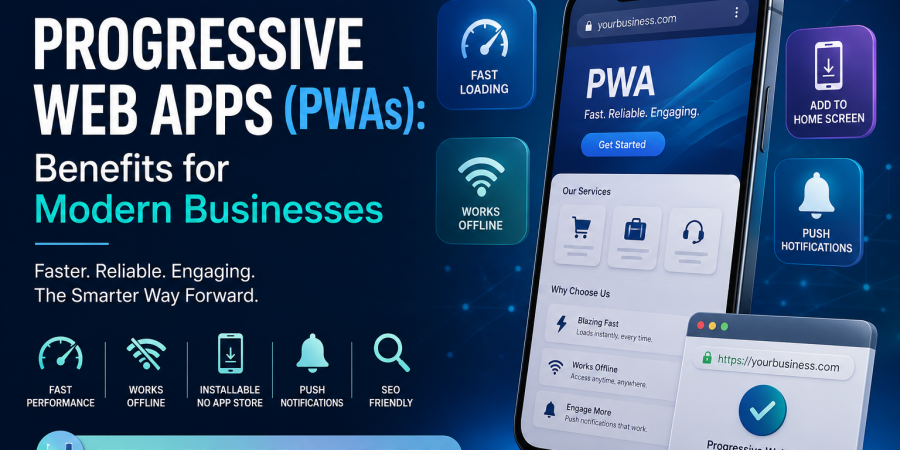
Progressive Web Apps (PWAs): Benefits for Modern Businesses
What They Are, Why They Matter, and Whether Your Business Needs One in 2026
In 2026, the line between a website and a mobile app has effectively disappeared. Businesses switching to Progressive Web Apps are seeing conversion rate increases of up to 76%, doubled daily active users, and development costs 50 to 70% lower than native apps. The technology behind that shift is the Progressive Web App, and businesses across every industry are quietly making the move.
If you have heard the term PWA but never fully understood what it means or why it matters for your
business, this guide covers everything you need to know.
What Is a Progressive Web App?
A Progressive Web App is a website built using standard web technologies, HTML, CSS, and JavaScript, that behaves exactly like a native mobile app.
Users can visit it through any browser, tap once to install it directly to their home screen, use it offline, and receive push notifications. There is no app store involved. No download required. No waiting for approvals.
The word “progressive” means it adapts to the device it runs on. On a modern smartphone with a strong connection, a PWA delivers a full app-quality experience. On an older device or slower network, it still loads, still works, and still performs. That adaptability is one of the core reasons businesses are choosing PWAs over both traditional websites and expensive native apps.
Why PWAs Matter More Than Ever in 2026
Users today have very little patience. A page that takes more than three seconds to load loses a significant portion of its visitors before they see a single word of content. App stores create friction, and people hesitate to download something they are not sure about. Native apps are expensive to build and even more expensive to maintain across iOS and Android simultaneously.
PWAs solve all three of these problems at once.By 2026, major technology platforms including Google, Microsoft, and Apple have all moved to support PWAs, signalling industry-wide recognition that this is no longer an emerging format. It is the standard.
Key Benefits of Progressive Web Apps for Businesses
Faster Loading Speed
Speed is not just a technical detail. It is a business outcome.
PWAs use a technology called service workers, which run in the background and cache key content on the user’s device. This means the app loads almost instantly, even on slow connections, because it is not fetching everything from scratch on every visit.
For businesses, faster loading directly translates to lower bounce rates, longer sessions, and higher conversions. Users who get what they need quickly come back. Users who wait leave.
Works Offline
One of the most underrated features of a PWA is its ability to function without an internet connection.
Starbucks built one of the most referenced PWAs in existence precisely because of this. Their progressive web app lets customers browse the full menu, customise drinks, and add items to their cart completely offline. When connectivity returns, the order goes through automatically. The result was a doubling of daily active web users, with web-based orders reaching near-parity with mobile app orders.
For any business where users might be on the move, in areas with patchy connectivity, or simply impatient
with slow loading, offline functionality is a genuine competitive advantage.
No App Store Needed
Getting a user to download a native app from an app store is genuinely difficult. It requires them to leave your website, find your app, wait for it to download, grant permissions, and then open it. A significant portion of users drop off at each of those steps.
With a PWA, the install happens directly from the browser in one tap. No app store visit. No download bar.
No friction.
This matters because the easier you make it for someone to engage with your business, the more of them
will.
One Codebase, Every Device
Building separate native apps for iOS and Android is expensive. Maintaining both, keeping them updated, and managing two separate development cycles doubles the cost and complexity.
A PWA runs on a single codebase and works across every device and operating system. According to research, PWAs cost 50 to 70% less to develop than equivalent native apps. For small and medium-sized businesses that want an app-quality experience without enterprise-level budgets, this is a significant advantage.
Push Notifications That Drive Re-engagement
Push notifications sent through PWAs work just like native app notifications. They appear on the user’s lock screen even when the browser is not open.
For businesses, this is a direct line back to customers who have already shown interest. Promotional offers, appointment reminders, order updates, new content alerts, all delivered without the user needing a native app installed.
Better SEO Than Native Apps
Native apps are essentially invisible to search engines. A PWA, being a website at its core, is fully indexed by Google. Every page is discoverable through organic search.
In 2026, search engines specifically favour fast-loading, mobile-optimised, performance-driven experiences. PWAs are built to meet those standards by default, which means they tend to rank better than slower traditional websites while remaining just as discoverable as any regular site.
Significantly Smaller File Size
The Starbucks PWA is 99.84% smaller than their native iOS app, at 233 kilobytes versus 148 megabytes. For users with limited device storage or data plans, this is the difference between using your service and choosing a competitor whose product actually fits on their phone.
Real Businesses, Real Results
The business case for PWAs is not theoretical. Here is what companies have seen after switching:
Starbucks doubled daily active web users after launching their PWA, with web orders reaching near-parity with their native mobile app.
Alibaba saw a 76% increase in conversion rates across browsers after launching their PWA.
Twitter Lite reduced data usage by 70% and saw a 65% increase in pages per session.
Pinterest reported a 60% increase in core engagements after rebuilding as a PWA.
Trivago achieved a 97% increase in engagement for hotel offers following their PWA launch.
AliExpress converted 104% more new users after switching to a PWA.
These are not small improvements. They represent fundamental shifts in how users interact with digital
products when the experience is fast, reliable, and frictionless.
PWA vs Native App vs Traditional Website
This is the question most business owners want answered before making a decision.
A traditional website is easy to build and maintain, but offers no offline capability, no push notifications, and limited engagement beyond the initial visit.
A native app delivers the best possible performance and device integration, but costs significantly more to build, requires separate development for iOS and Android, and depends entirely on app store discovery and downloads.
A PWA sits in the middle in the best possible way. It has the reach and discoverability of a website, the engagement features of a native app, and costs a fraction of either to build and maintain.
For most businesses, especially those focused on content, e-commerce, services, or customer engagement, a PWA is the most practical and cost-effective choice in 2026.
Where native apps still hold an edge is in advanced hardware access, such as camera, GPS, and Bluetooth, and in situations where an app store presence is specifically important for brand visibility. For everything else, a PWA competes directly and often wins.
Which Businesses Benefit Most from PWAs
PWAs are well suited to almost any type of business with a digital presence, but the strongest fit tends to be:
E-commerce businesses where speed and frictionless browsing directly drive sales.
Service businesses where booking, enquiries, and repeat engagement matter.
Media and content platforms where fast loading and offline reading improve retention.
Hospitality and travel brands where users access content in variable connectivity situations.
Healthcare and education providers where reliable access across devices is essential.
Any business currently spending on both a website and a native app, as a PWA can often replace both at lower total cost.
What Your Business Should Consider Before Building a PWA
Before starting, it is worth being honest about a few things.
PWAs are not a magic solution. They are a technology choice that works best when the underlying product and content are strong. A poorly designed PWA will still underperform.
There are also some limitations. On iOS, particularly in certain regions, Apple has restricted some PWA capabilities, which can affect push notifications and standalone display on iPhones. This is worth discussing with your development team before committing, especially if your audience is heavily iPhone-based.
That said, for the vast majority of business use cases in 2026, these limitations are minor compared to the advantages.
Frequently Asked Questions About Progressive Web Apps
What is a Progressive Web App (PWA)?
A Progressive Web App is a website built with standard web technologies that behaves like a native mobile app. Users can install it from their browser, use it offline, and receive push notifications, without visiting an app store.
How is a PWA different from a regular website?
A regular website requires an internet connection, cannot be installed on a home screen natively, and cannot send push notifications. A PWA can do all of these, while still being fully discoverable through search engines.
Are PWAs better than native apps?
For most businesses, PWAs offer comparable engagement features at 50 to 70% lower development cost. Native apps still have advantages in hardware access and app store visibility, but for content, e-commerce, and service businesses, PWAs are often the smarter choice.
Do PWAs work on iPhones?
Yes, PWAs work on iOS, though some features like push notifications have historically had limitations on Safari. Browser support has improved significantly in 2026, but it is worth reviewing iOS compatibility based on your specific requirements.
How much does it cost to build a PWA?
PWAs typically cost 50 to 70% less than building equivalent native apps for iOS and Android separately. The exact cost depends on complexity, features, and design requirements.
Can a PWA improve my website’s SEO?
Yes. Because PWAs are built on web technology, they are fully indexed by search engines. Their fast loading speed, mobile optimisation, and performance standards align closely with what Google prioritises in 2026, often resulting in better rankings than slower traditional websites.
How can I get started with PWA development for my business?
The best starting point is a conversation with an experienced web development team who can assess your current setup, audience, and goals, and recommend whether a PWA is the right move for your business.