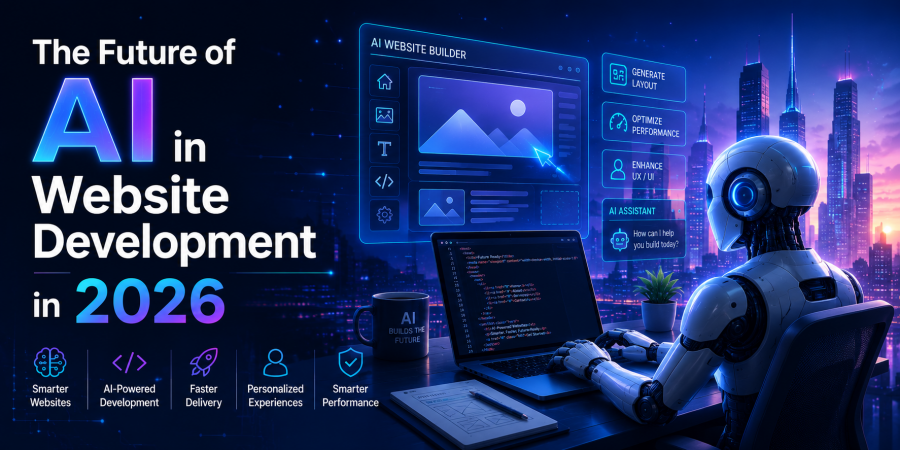
The Future of AI in Website Development in 2026
Trends, Tools & What It Means for Your Business
Artificial Intelligence is reshaping website development faster than anyone predicted, and 2026 is the year businesses can no longer afford to ignore it.
From how websites are coded and designed, to how they rank on Google and how they convert visitors into customers, AI is now woven into every layer of the process. Understanding where this is heading could be the most important digital decision your business makes this year.
This guide breaks down exactly what AI in website development looks like in 2026, what the data says, and what your business should be doing about it right now.
Why AI in Website Development Matters More in 2026 Than Ever Before
A year ago, most businesses were experimenting with AI. Today, it is a core part of how professional websites are built, optimised, and maintained.
According to Anthropic’s 2026 Agentic Coding Trends Report, 95% of professional developers now use AI tools every single week. AI is actively involved in roughly 60% of all development work happening globally. And the pace has accelerated sharply. AI coding agents now complete an average of 20 autonomous actions before requiring any human input, a figure that doubled in just six months.
For businesses, this changes how fast a high-quality website can be delivered, how well it performs for users, and how effectively it ranks in search results.
How AI Is Transforming Website Development in 2026
AI-Powered Code Generation
AI coding tools have moved far beyond simple autocomplete. In 2026, AI agents can plan a feature, read through an entire codebase, make coordinated changes across multiple files, run automated tests, and deliver a finished result, pausing only when genuine human input is needed.
In Q1 2025, only 34% of AI-assisted coding sessions involved multi-file edits. By Q1 2026, that figure had grown to 78%. Development teams using AI are now completing projects 30 to 50% faster. Not by cutting corners, but by automating repetitive mechanical work and focusing human effort where it truly counts.
For businesses commissioning websites, this means shorter timelines, better budgets, and more time invested in the strategic and creative decisions that make a website actually perform.
AI-Driven Website Personalisation
Every visitor on your website has different needs and a different reason for being there. Astatic website treats everyone the same. An AI-powered website does not.
In 2026, AI personalisation tools analyse each visitor’s browsing history, device type, location, and real-time behaviour to dynamically adjust what they see, including the headline, the featured service, the call to action, and sometimes even the page layout. Two people visiting the same URL can have completely different experiences, each more relevant to them
personally.
The results are well-documented. Websites using AI-driven personalisation are seeing conversion lifts of 15 to 30%. McKinsey research confirms that companies leading in personalisation grow revenue up to ten percentage points faster than those who lag behind. High-performing implementations are consistently achieving 25% revenue increases.
For a service business receiving 400 enquiries a month, even a 20% improvement means 80 additional conversations, without spending a single extra penny on advertising.
AI Chatbots and Conversational Interfaces
The clunky, limited chatbots of a few years ago have been replaced by AI-driven tools that hold genuinely useful, natural conversations with website visitors.
In 2026, these tools guide visitors through services, answer detailed questions, qualify leads, handle common objections, and hand off to a human only when truly needed, 24 hours a day, seven days a week.
A visitor arriving at 10 PM gets the same quality of response as someone calling during business hours. Well-implemented AI chatbots are boosting website conversion rates by 20 to 35%. For most service businesses, that is a significant and measurable revenue difference.
Agentic AI: The Development Shift Most Businesses Have Not Noticed Yet
The most significant development in web development in 2026 is one most business owners have not yet heard much about: agentic AI.
Traditional AI tools respond to questions. Agentic AI systems take independent action.
Give an agentic system a goal, such as optimising a mobile checkout flow, fixing performance issues, or rewriting service page copy in a new brand voice, and it works through the problem autonomously, using tools, making decisions, iterating, and delivering results with minimal human supervision.
Gartner forecasts that 80% of developers will work alongside autonomous AI agents by 2030. In practice, leading teams are already working this way in 2026. At TELUS, teams using agentic AI tools shipped code 30% faster while saving over 500,000 development hours.
For website owners, this means a new level of ongoing optimisation is now possible. Continuous improvement happening intelligently in the background, at a scale no human team could maintain alone.
AI and Search Engine Optimisation in 2026
Google’s search algorithms have become significantly more sophisticated, and AI sits at the centre of both the challenge and the solution.
Search engines in 2026 are far better at recognising genuine quality: content that is helpful, fast-loading, clearly structured, and trustworthy. They are also far less impressed by the tactics that used to work, including keyword stuffing, thin content, and manipulative link schemes.
AI-powered SEO tools now analyse your website against live search data, identify technical gaps, compare your content against what is currently ranking, suggest improvements based on actual user intent, and flag pages that are quietly underperforming. For businesses that have invested in their websites but are not seeing the traffic they expected, this is often exactly where the problem is hiding.
Automated Testing, Security and Performance
AI has transformed quality assurance in web development. These tools can now test an entire website, checking for broken links, performance bottlenecks, security vulnerabilities, accessibility failures, and UX friction points, faster and more thoroughly than any manual process.
Teams using AI-assisted code review report 40 to 60% less time spent on reviews, while catching more issues before they reach live users. The result is more stable websites, fewer post-launch problems, and development effort focused on improvement rather than firefighting.
Key Statistics: AI in Website Development 2026
- 95% of professional developers use AI tools every week (Anthropic, 2026)
- 78% of AI coding sessions now involve multi-file edits, up from 34% a year ago
- 30 to 50% faster development cycles with AI-assisted workflows
- 15 to 30% conversion lift for websites using AI-driven personalisation
- 20 to 35% conversion boost from well-implemented AI chatbots
- 10 to 25% revenue increase from AI personalisation, depending on implementation
- 40 to 60% reduction in code review time with AI quality tools
- 80% of developers expected to work with autonomous AI agents by 2030
Will AI Replace Web Developers?
This is one of the most common questions in the industry right now, and the honest answer is no.
AI handles the repetitive, mechanical, and time-consuming parts of web development with speed and consistency that no human team can match. But human expertise remains essential for understanding what a business actually needs, making design decisions that reflect a real brand identity, solving genuinely novel problems, and ensuring the final result connects with real people.
What is changing is the gap between teams that work fluently with AI and those that do not. That gap is widening fast, in delivery speed, output quality, and value delivered to clients.
The best websites being built in 2026 come from skilled humans using AI as a powerful tool, not from AI operating without human direction.
What Your Business Should Do Right Now
Audit your current website honestly. Is it fast? Is it mobile-friendly? Is it converting visitors into enquiries? If the answer to any of these is uncertain, that is the right place to start.
Focus on personalisation, chatbots, and SEO first. These three areas have the clearest and most consistent return on AI investment in 2026. They are also where smaller businesses can close the gap with larger competitors most quickly.
Work with a team that understands both design and technology. AI tools in the wrong hands produce generic, forgettable websites. The creative and strategic layer is still entirely human, and it matters more as AI makes average results accessible to everyone.
Think of your website as a long-term asset. A website built with AI-ready architecture, fast, structured, personalisable, and continuously optimised, improves over time as it learns from real users and adapts to how search engines evolve.
About DesignSages
We are a full-service web design and digital marketing studio. We work with businesses across industries and geographies to build websites that combine strategic thinking, strong design, and the best available technology, including AI-driven personalisation, chatbot integration, and continuous SEO optimisation.
We build websites that work: attracting the right visitors, converting them into enquiries, and representing a business the way it deserves to be represented online.
Get in touch: designsages.com/contact-us Call us: +91 906 188 1094
Frequently Asked Questions About AI in Website Development
What is AI in website development?
AI in website development means using artificial intelligence tools, including machine learning, natural language processing, and autonomous coding agents, to design, build, optimise, and personalise websites more effectively than
traditional methods allow.
How does AI improve SEO for websites in 2026?
AI SEO tools analyse live search data, identify technical issues, compare content against current top-ranking pages, and recommend ongoing improvements, helping websites rank higher on Google and attract more relevant
organic traffic.
Will AI replace web developers?
No. AI automates repetitive tasks and speeds up delivery, but human expertise remains essential for strategy, creative direction, brand identity, and complex problem-solving. The best results come from skilled humans working with AI, not
AI working alone.
How much can AI personalisation improve website conversions?
Current 2026 data shows conversion lifts of 15 to 30 % for websites using AI-driven personalisation, with McKinsey research confirming that leading personalisers grow revenue up to ten percentage points faster than competitors.
What AI tools are most effective for websites in 2026?
The highest-impact AI tools in 2026 are coding assistants for faster development, personalisation engines for adaptive user experiences, AI chatbots for round-the-clock lead engagement, and AI-powered SEO tools for continuous search performance.
How can DesignSages help with AI-powered website development?
Design Sages builds modern, AI-ready websites for businesses worldwide, combining design, strategy, and current
technology to create websites that rank well and convert visitors into customers. Reach us at +91 906 188 1094 or visit designsages.com.